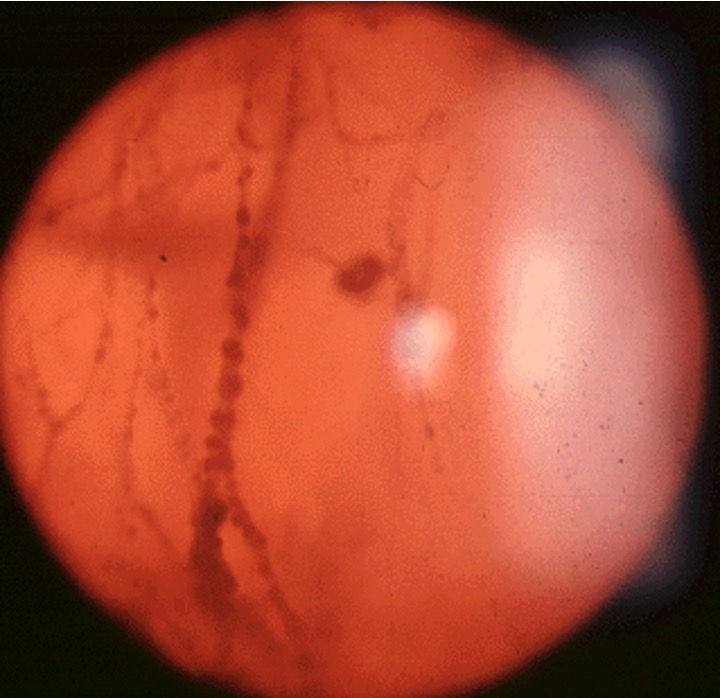
Vitreous Floaters
What Are Floaters?
Floaters appear as spots, strings, cobwebs, or shadowy shapes that drift across the visual field, moving when the eye moves and settling when the eye is still. They are not on the surface of the eye or on the glasses — they are inside the eye itself, casting shadows on the retina.
Floaters are caused by clumps, strands, or opacities within the vitreous gel that fills the eye. The vitreous is composed largely of water and collagen fibres, and over time these fibres can aggregate, condense, or detach from the retinal surface, creating particles that cast shadows on the retina and are perceived as floaters.
Posterior Vitreous Detachment
The most common cause of a sudden onset of new floaters in middle-aged and older adults is a posterior vitreous detachment (PVD) — a normal ageing process in which the vitreous gel separates from the retinal surface and collapses forward within the eye. As the vitreous pulls away, it often leaves a ring-shaped condensation of collagen (a Weiss ring) near the optic nerve, which is frequently visible as a prominent circular or irregular floater.
In the great majority of cases, PVD is entirely benign. The floaters it produces are often striking at first but tend to become less noticeable over weeks to months as they drift out of the central visual axis and as the brain adapts. Most people find they are able to ignore them in everyday life within a few months, particularly in environments with consistent lighting.
However, PVD can occasionally cause a retinal tear as the vitreous detaches — particularly if there are areas of abnormal adhesion between the vitreous and retina. This is why a sudden onset of floaters always warrants a dilated fundus examination to check for retinal tears or haemorrhage, even if the symptoms seem mild.
- A sudden, dramatic shower of new floaters — particularly dark spots or a red/smoky haze suggesting haemorrhage
- Floaters accompanied by flashing lights (photopsia)
- A shadow, curtain, or grey area advancing across the vision
- Any sudden change in vision alongside new floaters
These symptoms may indicate a retinal tear or retinal detachment, which requires urgent treatment. Do not wait for a routine appointment.
When Floaters Become a Problem
For most patients, floaters are manageable and improve over time. But for a significant minority the symptoms remain persistently and profoundly disruptive. Patients describe difficulty reading, driving, working on screens, or simply enjoying daily life, with floaters constantly intruding on their central vision. The psychological impact of living with intrusive floaters is frequently underestimated, and the dismissal of floater symptoms as merely cosmetic does a disservice to patients whose quality of life is genuinely affected.
What determines whether floaters are debilitating is not simply their size or density — it is the interaction between the floaters and the individual. Some patients have relatively few floaters but find them utterly intolerable; others have objectively dense vitreous opacities, such as asteroid hyalosis, and are entirely unbothered. This variability reflects a real and important difference in the capacity for neuroadaptation — the brain’s ability to suppress and habituate to a persistent visual stimulus. For some people this suppression happens naturally and quickly; for others, for reasons that are not fully understood, it does not occur, and the floaters remain as intrusive on day three hundred as they were on day one.
My approach to surgical decision-making reflects this reality. The threshold for offering vitrectomy is not defined purely by the number or density of floaters — it is defined by the impact on the individual patient. A patient with relatively few floaters who finds them genuinely debilitating, and in whom conservative management has not brought relief, is as reasonable a surgical candidate as one with objectively dense vitreous opacification. What matters is a clear, consistent, and honest account of how the floaters are affecting daily life, and a shared understanding of what surgery can and cannot achieve.
Surgical Treatment: Vitrectomy for Floaters
The definitive treatment for symptomatic vitreous floaters is pars plana vitrectomy — the same surgical procedure used to treat retinal detachment and macular conditions. Through three 25-gauge ports in the white of the eye, the vitreous gel — and the floaters within it — is removed and replaced with clear saline. The result is an optically clear vitreous cavity and, for the overwhelming majority of patients, complete resolution of the floaters.
Patient satisfaction following vitrectomy for floaters is very high in appropriately selected cases. The key is careful patient selection: surgery is most appropriate for patients with dense, visually significant floaters that have persisted for at least several months despite conservative management, and in whom the impact on daily life is clear and substantial.
Risks of Vitrectomy for Floaters
Because floaters are a benign condition, the risk-benefit calculation for surgery requires particularly careful consideration. The risks of vitrectomy are the same as for any vitreoretinal procedure:
- Cataract — the most common consequence in patients who retain their natural lens; typically develops within one to two years and is readily treated
- Retinal tear or detachment — uncommon but requires prompt treatment
- Infection (endophthalmitis) — rare but serious
- Incomplete resolution — very occasionally new floaters can develop after surgery, though this is uncommon
- Raised intraocular pressure — usually temporary and manageable
These risks are real but small, and for patients with genuinely disabling floaters they are generally outweighed by the likely benefit. The decision to proceed with surgery is always made jointly, with a full and frank discussion of what the operation can and cannot achieve.
A Note on Laser Vitreolysis (YAG Laser)
YAG laser vitreolysis — in which a laser is used to fragment floaters within the vitreous — is available at some centres and can be helpful in selected cases, particularly for a single, well-defined floater such as a Weiss ring in a suitable position. It is not a procedure I perform, but I am happy to discuss whether it might be appropriate for a particular patient and to advise on referral if so.
What to Expect at Consultation
At your consultation I will take a detailed history of your floater symptoms — their onset, character, severity, and impact on your daily life — and perform a thorough examination of the vitreous and retina, including dilated fundus examination. This allows me to confirm the diagnosis, exclude any underlying retinal pathology, and assess whether the floaters are of a type and severity that is likely to benefit from surgical intervention.
If surgery is appropriate, I will explain the procedure in detail, discuss the risks and realistic expectations, and ensure you have all the information you need to make an informed decision. There is no obligation to proceed — many patients find that a clear explanation and reassurance that their floaters are benign is sufficient, and choose to manage conservatively.
Private Floater Assessment and Surgery in London
Consultation and vitrectomy for floaters are currently available privately at Moorfields Eye Hospital . From September 2026, surgery will also be available at 1 Welbeck, Marylebone , which will become the principal centre for my adult private surgical practice.
Book a Consultation
To discuss floaters or arrange an assessment, please contact my secretary Alison Anscombe:
📞 +44 7974 015691 | 📧 [email protected]
Or use the contact form on this website .
Mr Robert Henderson BSc MBBS MD FRCOphth is a Consultant Vitreoretinal Surgeon at Moorfields Eye Hospital and Great Ormond Street Hospital, and Clinical Lead for Ophthalmology at GOSH